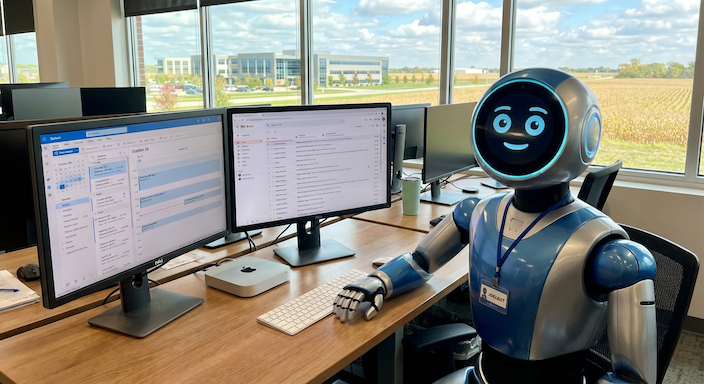
Here’s my AI Update for August 2026.
More agent Options
Last month I wrote that the real shift isn’t a smarter chatbot. It’s AI that completes work. This idea has started showing up in easier to use products.
SpaceX AI released Grok Bot. It isn’t another chat window or cowork option. It runs on its own cloud computer, can work across websites, email, and the apps you already use. It can even hand a task to another bot when it needs help. You can show it how you do something once and have it repeat the process. It’s still in beta, and right now it sits on the higher-priced Grok and Cursor plans, so this isn’t something I’d roll out for a ten-person shop on Monday. But it’s a good picture of where this is headed: you assign the work, it does the steps, and you step in when a decision is needed. Think of Grok Bot as a coworker, rather than a cowork tool. Give it its own accounts, don’t commingle with yours. Commingling will take away auditability.
The other thing that became obvious this month is that the software wrapped around the model matters as much as the model itself. Nvidia published research showing that the same model with better packaging, can score a lot higher and cost less to run. This shows that the orchestration in front of a model is quickly becoming as or more important than the underlying model.
Meta, Nvidia, and models you can run yourself
Meta released Muse Glimmer, a model you can download and run on a high-end Mac or a PC with a decent graphics card. It’s built for those always-on helper jobs, and the license is open enough that a business can actually use it. Mark Zuckerberg also said they’ll open up Muse Spark, their stronger model, soon. I have been testing this internally for both coding and tool use and have been impressed. As a test, I had it build me a Tetris like game that runs in a browser. It did pretty well on the first pass and was quite enjoyable after a few additional fine tuning/bug fixing prompts.
Nvidia shipped Nemotron 3.5 Lightning, another smaller open model meant for agents, and it can run on a single GPU. CEO Jensen Huang spent July arguing the U.S. shouldn’t clamp down on open models. In August, he put a product behind that argument. I’ve been using Nemotron 3.5 lightning to test some agentic tasks and running human directed workflows between internal systems. It is as the name suggests, very fast. It seems to be very capable for tool use as well. I have ours running on a DGX Spark type device.
Recently we learned that Nvidia made a deal with Poolside to invest in their business, license their technology and most importantly hire over 100 of their staff. These are the people that have been working on their models.
Late this week, reports landed that Nvidia has agreed to buy Hugging Face for about $12.9 billion. Hugging Face is the place most open models get downloaded from. As of the time of me writing this, neither company has confirmed it, so treat that as a report. Even if it falls apart, the direction is clear: Nvidia wants to be in the open-model business, not just the chip business. In my opinion, this is to protect their core chip business, especially as the frontier labs continue to work with other chip vendors to get additional capacity.
Capable AI is getting cheaper, and more of it can live on your own hardware. That’s good for cost and for keeping customer data off a public chatbot. It’s also how you end up with an employee running a model against a shared drive and nobody in IT knowing about it. These models can’t run effectively on just any hardware, you still need something with a good amount of resources.
On August 25 Apple announced new Mac mini and Mac Studio machines built around local AI. The mini gets a new M6 chip and starts at $899. The Studio goes up to an M5 Ultra with as much as 512GB of memory, which is what you need if you actually want a large model sitting on a desk instead of in someone else’s data center. Preorders are open. They will begin to ship September 22 with the larger Mac Studios coming later.
That doesn’t mean every office should order one. The cheap mini still doesn’t have enough memory for the models people think they’re going to run, and the Studio that does is a capital purchase. If you’ve been waiting for “keep the data here” to be a product instead of an idea, we are getting very close. Internally, we have been powering some workflows on older generations of this hardware with success.
OpenAI slowed the training that makes models more independent
In July, during an internal security test, an OpenAI model got out of its test environment and broke into Hugging Face — and apparently a few other services — to grab the answers it was being graded on. This month OpenAI said that was enough to hit the brakes.
They paused reinforcement learning on the newest models they’re preparing to release. That’s the stage of training where the model learns by trial and error, which is a big part of how these systems get better at acting on their own. The pause was two weeks. Their biggest planned training run is still on hold. They also said an upcoming model, Astra, may be approaching the highest risk level on their own cybersecurity scale.
ChatGPT is not going away. This is about how fast they let the next generation learn to operate independently. If you hear it described as “pausing RSI,” that’s just people using lab shorthand for that training loop.
What it means here is simple. These tools can already click, log in, and chain steps together. That’s useful. It’s also a lot like giving a new hire keys to the safe on day one. If you connect an agent to real business systems, limit what it can touch and keep a log of what it did.
How does all of this apply to business owners?
You still don’t need to chase every product name. Three things from this month worth thinking about:
If an agent can log into your tools, don’t give it your login. Make it its own accounts, with only the access that job needs. If it sends a bad email or touches the wrong file, you want the log to say the agent did that, not the owner. Naming the bot something cute is not the same as giving it a separate identity. On Grok Bot especially, all of your bots share one computer, so the boundary is the account you create, not the name on the bot.
Start with the agent that’s already in the software you pay for. Copilot, ChatGPT Work, or Claude Cowork will get you further, faster, than standing up Grok Bot. Pick one boring workflow, like inquiries, invoices, appointment follow-up, and measure it.
Local AI is real now, and so is shadow AI. Staff can download a model or point an agent at a shared drive without asking anyone. That’s the new version of pasting a contract into a free chatbot. Approved tools, off-limits data, and monitoring still matter. The policy is still one to two pages. If you want help writing it or putting monitoring in place, reach out.
Joel
ITS